“I keep replaying the conversation. I thought I was just annoyed, but I think there was more to it.”
Reflect
Break down big emotions.
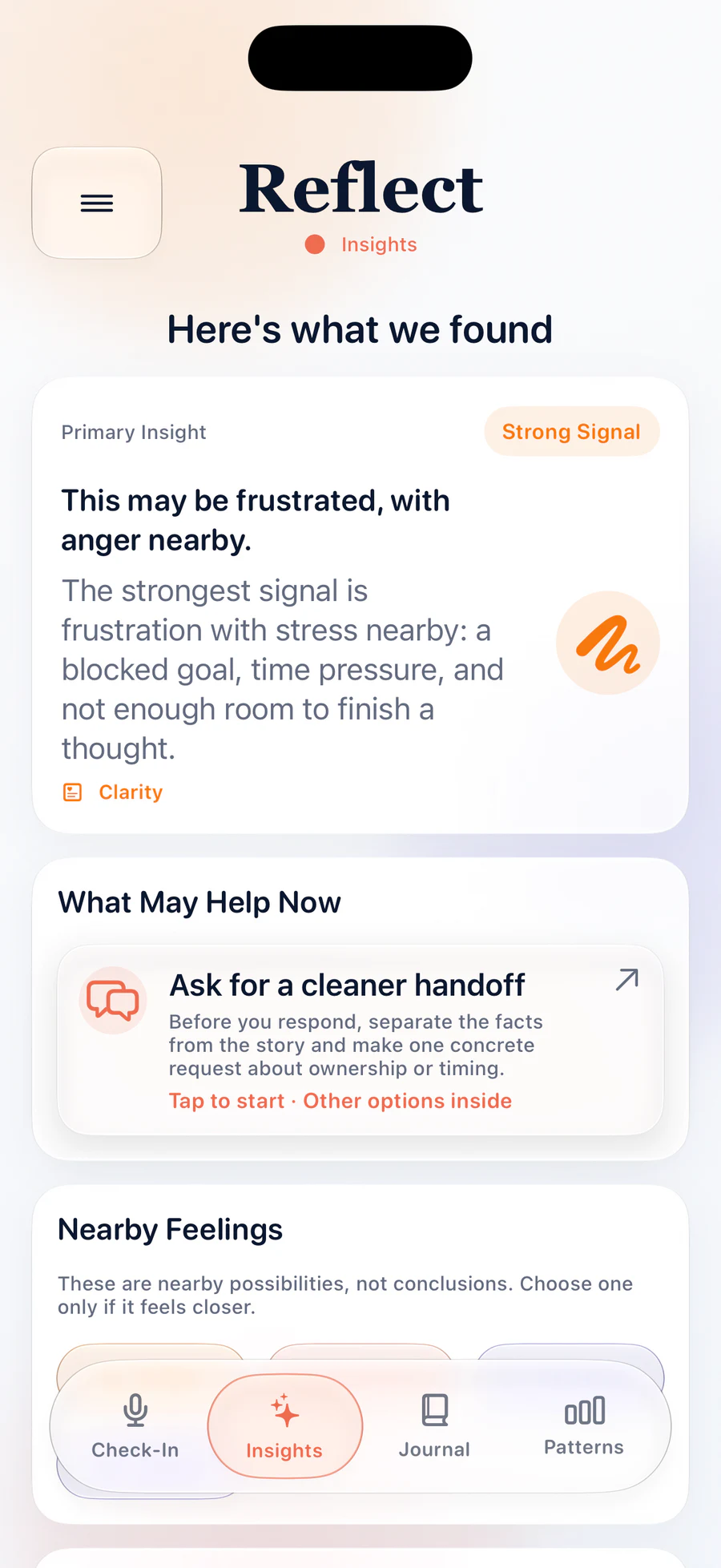
Talk through a difficult moment. Reflect turns your words into a careful hypothesis, shows the clues behind it, and helps you choose one useful next step.
Official store destinations are being confirmed before launch.
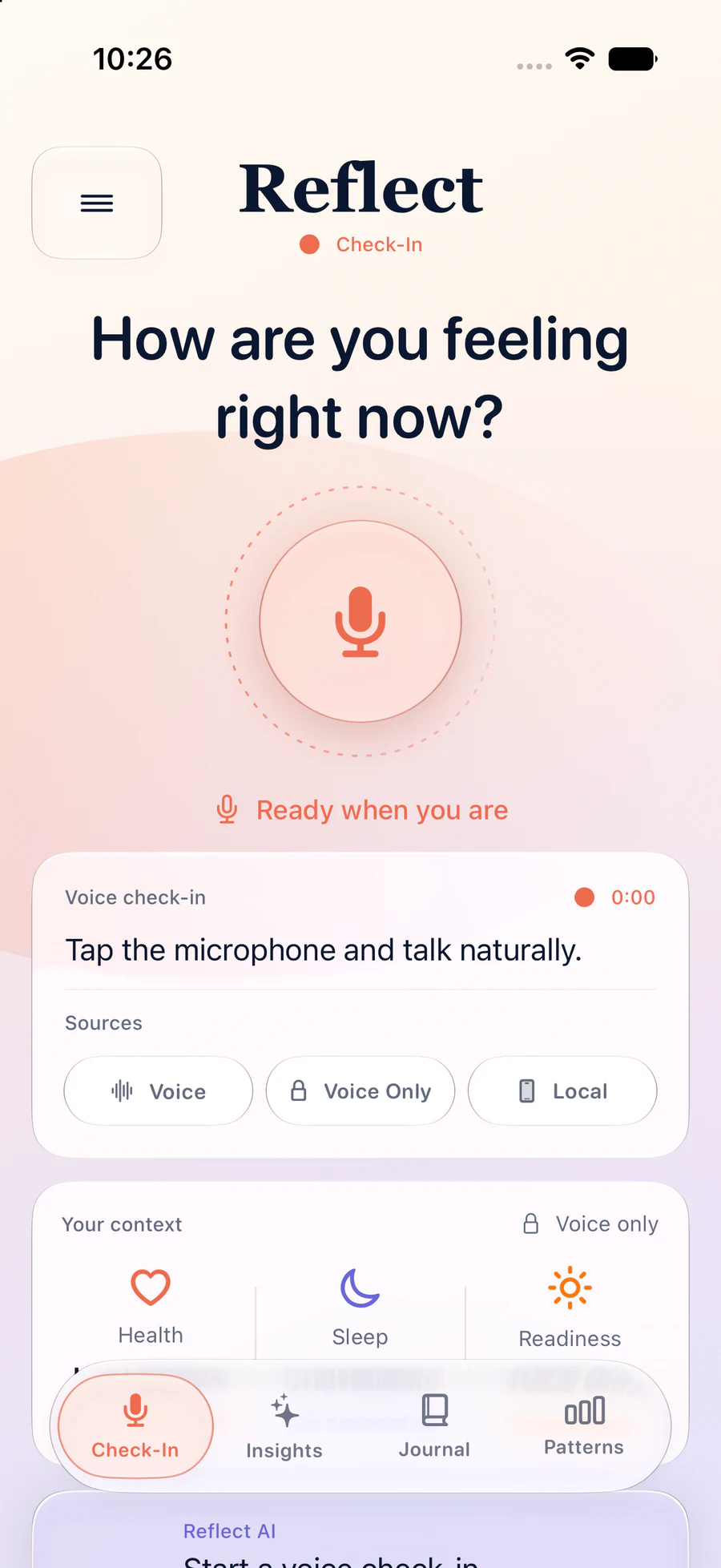
You do not always know what you feel before you start talking.
Some moments are too tangled for a mood scale. Reflect begins with the situation itself: what happened, what stood out, what keeps replaying, and what may need your attention.
- After an argument
- Before responding to a difficult message
- When a familiar pattern appears again
- When something matters but is difficult to name
Speak it
Start with what happened.
Reflect listens only after you begin a check-in, so you can talk naturally about the moment in front of you.
Context firstTentativeYour call
The Reflect difference
Clarity you can use.
A reflection you can shape.
One fictional check-in, shown as a calm loop: speak, notice, confirm, act.
This may be frustration with a layer of hurt.
Clues Reflect noticed- The moment keeps replaying.
- Something important may have felt unresolved.
- Your words moved from irritation toward disappointment.
FrustrationHurtDisappointmentResentment
How well does this fit what you are feeling right now?
Why Reflect is different.
Hypothesis, not certainty
Reflect suggests what may be happening without claiming to know exactly how you feel.
Context, not tone alone
Reflect considers the situation and language you provide—not one isolated vocal cue.
Your call, not passive acceptance
You can see why an interpretation appeared, then confirm, refine, or reject it.
Action, not analysis alone
The goal is one bounded, useful next step.
Emotional language with a visible key.
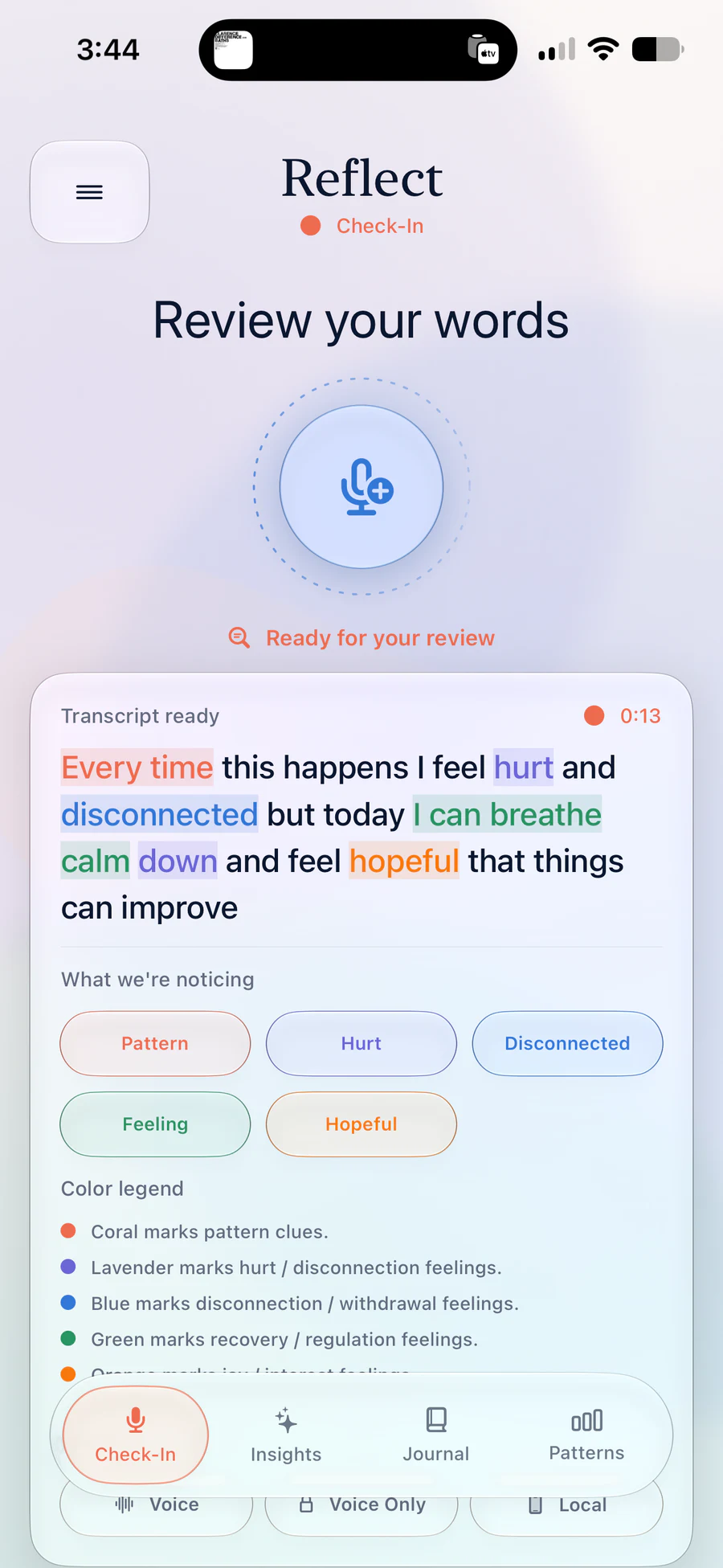
Words and chips use the same neighborhood color wherever they appear. The full vocabulary stays available in the glossary.
UncertaintyOverwhelmBlocked GoalsUnfairness / ComparisonProtection / BoundaryHurt / DisconnectionSelf-JudgmentFatigue / DepletionDisconnection / WithdrawalConnection / WarmthJoy / InterestRecovery / Regulation
Read Reflect’s plain-language glossary Privacy should be understandable.
Reflect’s privacy details are being verified before launch. The full Privacy page will explain recordings, transcription, storage, deletion, accounts, third parties, analytics, training use, and your controls in plain language.
Read the privacy overview- 01Your choiceChoose what to share
Start a check-in when you’re ready. Reflect only uses the sources you turn on.
- 02Careful by designReflect makes a first pass
It looks at your words and chosen context for possible clues—not a verdict.
- 03You decideYou check the reflection
Read the transcript, see the clues, and keep, change, or reject what does not fit.
- 04Before launchKnow what happens next
Before launch, we’ll publish clear retention and deletion details in plain language.
Reflect suggests.
You decide.
This may be frustration.
A useful reflection does not require Reflect to be unquestioningly right. You can confirm, refine, or reject what it presents.
A response Reflect might serve
ConfirmedKeep the feeling. Go one layer deeper.
Reflect can keep frustration as the working insight, then help you understand what it may be protecting or pointing toward.
Possible reflection
Frustration fits. It may be showing you that something important still feels unresolved.
Useful next step
Before responding, name the one thing you wish had been understood.
Clear limits are part of trust.
Reflect is designed for self-reflection and emotional clarity. It is not a crisis service, medical provider, therapist, diagnostic instrument, or substitute for professional care.
Read safety and limitationsQuestions, answered plainly.
No. Reflect is designed for self-reflection and emotional clarity. It is not therapy, medical care, or a substitute for professional support.
No. Reflect offers a possible interpretation based on the situation and language you share. You decide what fits.
You can confirm, refine, or reject a reflection. Insights are possibilities, not conclusions, and you remain in control of what you keep.
Personal-baseline details are still being verified for launch. Reflect will not claim that one recording establishes a baseline or that a recurring pattern proves a diagnosis.
The recording, transcription, storage, deletion, analytics, third-party, and training details are under technical review. Verified facts will be published on the Privacy page before launch.
Reflect uses the microphone only when you start a check-in and uses speech recognition to show the transcript it analyzes. Health context, saved places, and nearby calendar context are optional sources you can choose to connect.
This marketing site never requests microphone access. The app’s microphone behavior and permissions will be documented with the verified launch privacy details.
Reflect is not a crisis or emergency service. If you or someone else may be in immediate danger, contact local emergency services.
Supported devices and operating-system requirements will be published when the official store listings are confirmed.
Official availability links are not yet confirmed. This page will show only live, pre-order, or pre-registration badges once their destinations are verified.
Account requirements are still being verified and will be stated clearly before launch.